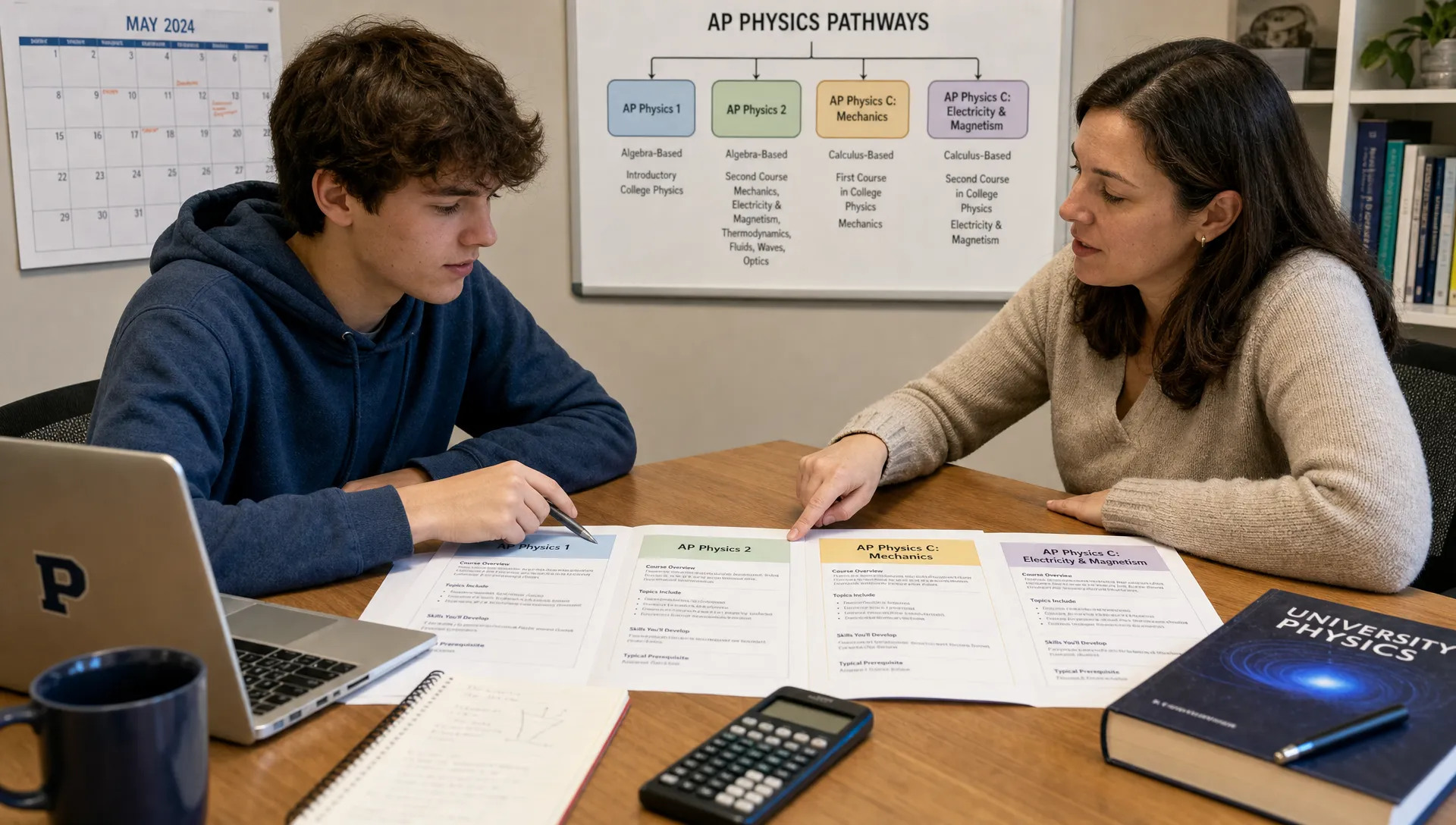
Planning AP Physics in 2026 can feel confusing because AP Physics is not one course. It is a set of four different courses, each with its own math level, topic sequence, and exam style. A student who chooses the wrong one may spend the year fighting the curriculum instead of learning physics.
The good news is that the AP Physics curriculum is very logical once you understand the pathway. AP Physics 1 and AP Physics 2 are algebra-based. AP Physics C: Mechanics and AP Physics C: Electricity and Magnetism are calculus-based. All four reward the same core habits: clear reasoning, strong representations, lab thinking, and the ability to explain why an equation applies.
This guide breaks down the 2026 AP Physics curriculum so students and parents can choose the right course, understand what will be tested, and plan preparation without relying on outdated assumptions.
What the AP Physics curriculum means in 2026
The AP Physics curriculum is designed to mirror introductory college physics, but it is not just a list of formulas. The College Board organizes each AP Physics course around content topics and science practices. That means students are expected to solve problems, interpret graphs, design or analyze experiments, justify assumptions, and connect equations to real physical situations.
For official course descriptions and annual updates, students should always check the College Board AP Physics 1 course page and the corresponding pages for the other AP Physics courses. This is especially important if you are using older textbooks or prep books, because the AP Physics exams were revised in recent years.
For 2026 students, the most important point is this: AP Physics is now more unified in exam structure, but the courses still differ strongly in content and mathematical depth. A student can be excellent at AP Physics 1 and still need time to adjust to AP Physics C because calculus changes the way motion, force, energy, fields, and change are modeled.
The four AP Physics courses at a glance
| Course | Math level | Typical place in sequence | Main curriculum focus | Best fit for |
|---|---|---|---|---|
| AP Physics 1: Algebra-Based | Algebra and trigonometry | First AP Physics course | Mechanics, rotation, oscillations, fluids | Students taking their first serious physics course |
| AP Physics 2: Algebra-Based | Algebra and trigonometry | After AP Physics 1 or a strong first physics course | Thermodynamics, electricity, magnetism, optics, modern physics | Students who want broad physics without calculus |
| AP Physics C: Mechanics | Calculus | With or after calculus | Motion, forces, energy, momentum, rotation, oscillations, gravitation | Future engineering, physics, or physical science majors |
| AP Physics C: Electricity and Magnetism | Calculus | Usually after or alongside C Mechanics | Electric fields, potential, circuits, magnetic fields, induction | Students aiming for engineering, physics, or advanced STEM credit |
AP Physics 1 and AP Physics 2 are not easier simply because they are algebra-based. They can be conceptually demanding because the exam often asks students to explain relationships without relying on advanced math. AP Physics C is more mathematically sophisticated, especially where derivatives, integrals, and differential reasoning appear naturally.
If you are deciding between AP Physics 1 and AP Physics C, Tangible Learning has a separate comparison of AP Physics 1 vs AP Physics C that looks more closely at prerequisites, student goals, and course difficulty.
AP Physics 1: the foundation course
AP Physics 1 is the most common starting point for students entering the AP Physics pathway. It is algebra-based, but that does not mean it is plug-and-chug. The curriculum is built around understanding how and why objects move.
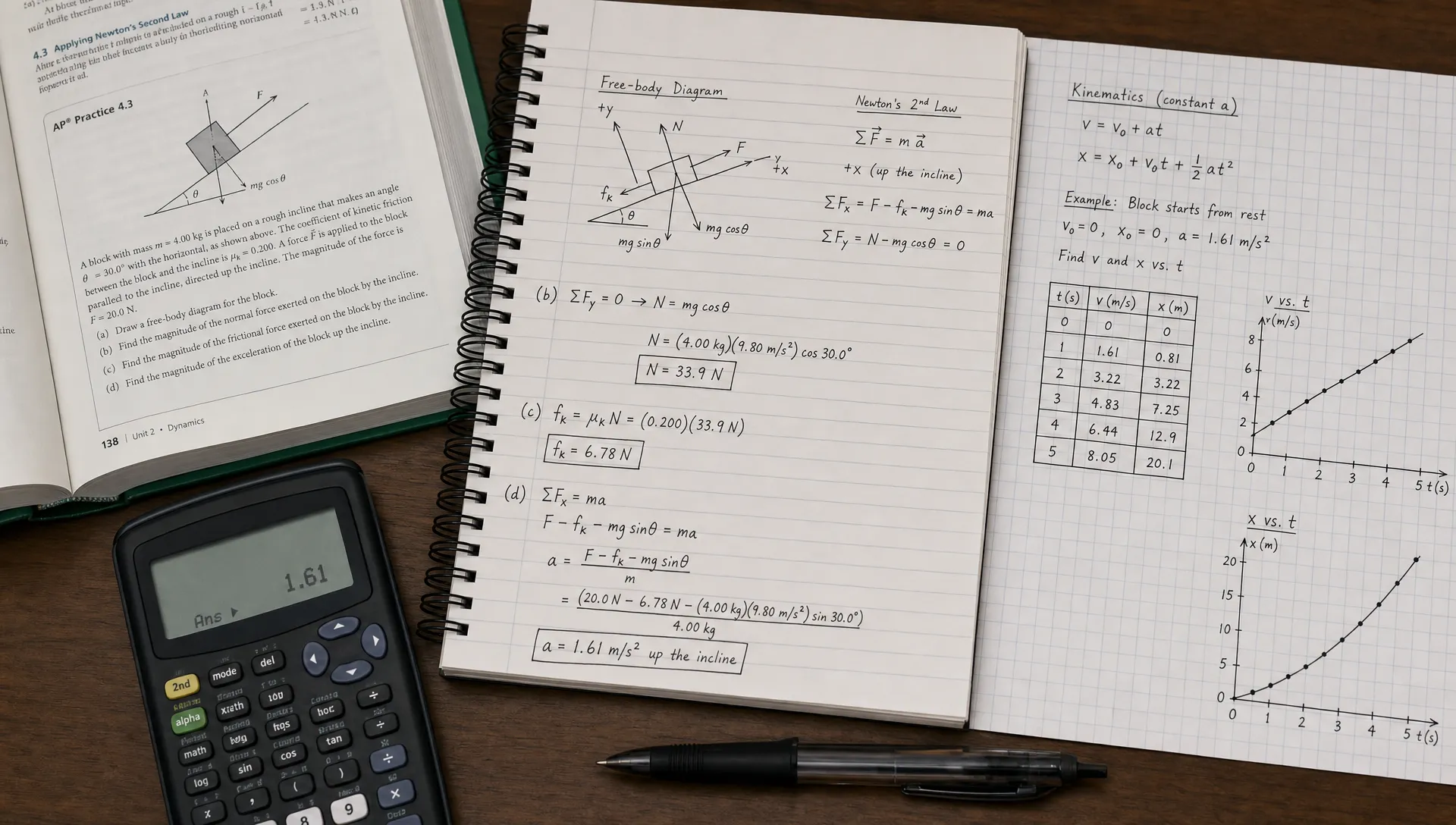
The 2026 AP Physics 1 curriculum focuses on mechanics and related physical systems. Students should expect topics such as kinematics, forces, work, energy, power, momentum, torque, rotational dynamics, rotational energy and angular momentum, oscillations, and fluids.
The core challenge in AP Physics 1 is learning to model situations correctly. For example, a block sliding down an incline may involve vectors, normal force, friction, energy transfer, and motion graphs. The best students do not just search for an equation. They identify the system, define assumptions, choose a representation, and then solve.
Mechanics is the backbone of this course. If you want a deeper topic-by-topic breakdown, the AP Physics mechanics guide is a useful companion for reviewing motion, forces, energy, and momentum.
AP Physics 2: the broad second algebra-based course
AP Physics 2 is also algebra-based, but its content feels very different from AP Physics 1. Instead of spending the year mainly on mechanics, students move into topics that explain heat, electricity, magnetism, light, and modern physics.
The AP Physics 2 curriculum for 2026 includes thermodynamics, electric force, electric fields, electric potential, electric circuits, magnetism, electromagnetic induction, geometric and physical optics, and modern physics. Depending on the school, AP Physics 2 may be taken after AP Physics 1 or after another strong introductory physics course.
Students often underestimate AP Physics 2 because the math prerequisites are not as high as AP Physics C. That is a mistake. AP Physics 2 requires comfort with abstract ideas. Electric potential, field superposition, magnetic force, interference, and atomic models can be hard to visualize at first.
A strong AP Physics 2 student learns to move between diagrams, graphs, equations, and verbal explanations. For example, a circuit problem may ask for current, but the reasoning may depend on energy conservation, resistance relationships, and the behavior of capacitors over time.
AP Physics C: Mechanics
AP Physics C: Mechanics covers many of the same broad mechanics areas as AP Physics 1, but it does so using calculus. This changes the level of precision expected from students.
In AP Physics C: Mechanics, students study kinematics, forces, work, energy, power, linear momentum, rotation, oscillations, and gravitation. The calculus-based approach allows students to handle situations where acceleration, force, or velocity changes continuously. Instead of only using constant-acceleration equations, students may integrate acceleration to find velocity or use derivatives to analyze motion from a position function.
This course is especially relevant for students considering engineering, physics, applied mathematics, or other quantitative STEM fields. Many colleges are more likely to award physics credit for AP Physics C than for algebra-based AP Physics, but policies vary. Students should confirm credit rules with the AP Credit Policy Search and with individual universities.
AP Physics C: Electricity and Magnetism
AP Physics C: Electricity and Magnetism is a calculus-based course that focuses on electric and magnetic phenomena. Students usually take it after AP Physics C: Mechanics or while taking a rigorous physics sequence.
The curriculum includes electrostatics, electric fields, electric potential, conductors, capacitors, dielectrics, circuits, magnetic fields, magnetic forces, and electromagnetic induction. Calculus appears naturally in topics such as field calculations, flux, potential, and changing currents or fields.
This course can feel abstract because many quantities are invisible. Students cannot see electric fields or magnetic flux directly, so diagrams and mathematical models become essential. A successful student learns to ask questions such as: What is the source of the field? What symmetry exists? What path or surface makes the calculation simpler? What physical quantity is conserved?
What changed for students using older materials
One of the biggest risks for 2026 students is preparing with outdated AP Physics resources. Older books can still contain useful practice, but they may not reflect the current curriculum or exam format.
Watch for these issues when choosing study materials:
- AP Physics 1 now emphasizes a mechanics-focused sequence that includes fluids, so older resources with a different topic map may not align well.
- AP Physics 2 focuses on thermodynamics, electricity and magnetism, optics, and modern physics, so students should check that their materials match the current course structure.
- AP Physics C exams are no longer the short legacy 90-minute exams that many older prep books were built around.
- Current AP Physics preparation should include experimental reasoning, graph interpretation, and written justification, not just numerical problem sets.
This does not mean every old problem is useless. A good force, energy, or circuit problem can still build skill. But your main curriculum map, mock exams, and final review should match the current College Board format.
How the 2026 AP Physics exams assess the curriculum
For the current AP Physics exam format, students should plan for a three-hour exam in each AP Physics course. The structure is broadly consistent across AP Physics 1, AP Physics 2, AP Physics C: Mechanics, and AP Physics C: Electricity and Magnetism.
| Section | Format | Time | Weight | What students must show |
|---|---|---|---|---|
| Multiple-choice | 40 questions | 80 minutes | 50% | Fast reasoning, topic recognition, graph and representation skills |
| Free-response | 4 questions | 100 minutes | 50% | Clear setup, explanation, experimental thinking, mathematical reasoning |
The equation sheet and calculator are helpful, but they do not replace understanding. Many AP Physics questions are designed so that choosing the correct principle is harder than doing the arithmetic. A student who memorizes equations but cannot explain when they apply will struggle.
Free-response questions are especially important because they reveal how a student thinks. You may need to derive a relationship, design an investigation, interpret data, draw a graph, compare two physical scenarios, or justify a claim in words. Partial credit matters, so clear reasoning can earn points even when the final answer is not perfect.
For a practical breakdown of how to structure written solutions, Tangible Learning's AP Physics FRQ guide explains how to approach free-response questions, earn partial credit, and avoid common mistakes.
How to choose the right AP Physics course
The right AP Physics course depends on your math background, previous physics experience, academic goals, and school schedule. The most advanced-sounding course is not always the best choice.
| Student situation | Recommended direction | Reason |
|---|---|---|
| First formal physics course | AP Physics 1 | Builds the mechanics foundation without requiring calculus |
| Completed AP Physics 1 and wants broader physics | AP Physics 2 | Extends into thermodynamics, electricity, magnetism, optics, and modern physics |
| Taking calculus and aiming for engineering or physics | AP Physics C: Mechanics | Aligns better with many STEM college programs |
| Strong in C Mechanics and continuing advanced STEM | AP Physics C: Electricity and Magnetism | Adds the calculus-based field and circuit content often needed for engineering |
| Unsure about calculus readiness | Start with AP Physics 1 or strengthen calculus first | Physics C becomes much harder without comfort in derivatives and integrals |
Students should also consider workload. AP Physics C: Mechanics plus AP Physics C: Electricity and Magnetism can be a demanding combination, especially alongside AP Calculus, AP Chemistry, AP Biology, or advanced humanities courses. It can be worth it for the right student, but only with a realistic schedule.
For students outside the U.S. education system, such as those also considering IB, Cambridge, or A-Level courses, the choice should be based on university goals. U.S.-focused applicants may use AP Physics for credit or admissions strength, while international applicants should check how target universities interpret AP exam scores.
A practical study plan for the 2026 AP Physics curriculum
A strong AP Physics study plan should follow the curriculum, but it should not treat every unit as a separate island. Physics builds. Weakness in vectors, free-body diagrams, graphs, or proportional reasoning will show up again and again.
| Preparation phase | Main focus | What to produce |
|---|---|---|
| Early course phase | Units, vectors, graphs, forces, basic modeling | Clean notes, equation meanings, diagram habits |
| Middle of the course | Multi-step problems and lab reasoning | Mixed-topic practice sets and error logs |
| Two to three months before the exam | Timed multiple-choice and free-response practice | Scored FRQs, corrected solutions, topic gap list |
| Final month | Full review and exam simulation | Practice exams, formula sheet fluency, concise explanations |
The most effective students review continuously. They do not wait until April to discover that they never fully understood torque, electric potential, or magnetic force. After each unit, write down three things: the central principle, the most common representation, and the condition under which each key equation applies.
Another useful habit is keeping an error log. Do not just record that an answer was wrong. Record why it was wrong. Was it a sign error, a missing force, a misunderstood graph, an incorrect assumption, or a weak explanation? Over time, patterns in your error log tell you exactly what to fix.
Common AP Physics curriculum traps
Many AP Physics students work hard but study in ways that do not match the exam. The curriculum rewards reasoning, so preparation needs to go beyond solving long lists of similar problems.
Common traps include:
- Memorizing formulas without knowing the assumptions behind them.
- Treating graphs as decoration instead of physical information.
- Avoiding written explanations because the final answer seems more important.
- Practicing only your favorite units and ignoring weaker topics.
- Skipping lab-style questions until the final weeks.
The solution is not to study more randomly. It is to study more deliberately. When you solve a problem, ask yourself what principle you used, why it applies, what representation helped, and how the answer would change if one condition changed.
Frequently Asked Questions
Which AP Physics course should I take first in 2026?
Most students should begin with AP Physics 1 unless they already have a strong physics background and are taking or have completed calculus. Students aiming for engineering may choose AP Physics C: Mechanics if they are mathematically ready.
Is AP Physics C harder than AP Physics 1?
AP Physics C is usually harder mathematically because it uses calculus. AP Physics 1 can still be conceptually difficult because it requires strong explanations, graphs, and modeling without relying on calculus.
Do I need calculus for AP Physics 1 or AP Physics 2?
No. AP Physics 1 and AP Physics 2 are algebra-based courses. You should be comfortable with algebra, trigonometry, vectors, proportional reasoning, and graphs.
Can I self-study AP Physics for 2026?
It is possible, but it is challenging. AP Physics includes lab reasoning, written explanations, and multi-step conceptual questions, so self-study students need current materials, official practice, and feedback on free-response work.
Are old AP Physics prep books still useful?
Some old practice problems are useful, but students should be careful. The curriculum and exam format have changed, so 2026 preparation should be based on current College Board-aligned materials.
How much time should I spend preparing for AP Physics?
A consistent weekly routine is better than last-minute cramming. Many students benefit from regular problem practice, FRQ writing, and review throughout the year, with timed exam practice increasing in the final months.
Need help turning the AP Physics curriculum into a clear plan?
AP Physics becomes much more manageable when the syllabus is broken into concepts, skills, and exam habits. Tangible Learning offers personalized online Physics tutoring for AP students, with lessons focused on conceptual understanding, syllabus-specific preparation, and exam strategy.
If you want support choosing the right AP Physics path or preparing for the 2026 curriculum, explore Tangible Learning and start with resources or a free trial lesson.
Ready to Build Your AP Physics Plan?
Get in touch to discuss the right AP Physics course for you and a preparation plan tailored to the 2026 curriculum.
We'll respond within 24 hours to help you plan your AP Physics journey.